Middlesbrough's ground conditions shift dramatically between the alluvial floodplain of the River Tees and the higher ground around Acklam and Marton. The soft estuarine clays and peat layers near the river demand a completely different foundation approach compared to the firmer glacial tills found south of the town. For sites on the former Teesside steelworks land, deep soil mixing (DSM) design becomes essential to treat contaminated fill and improve bearing capacity before any superstructure load is applied. A proper DSM design in Middlesbrough must account for these sharp lateral transitions in soil stiffness and strength. Before specifying column layout, we always recommend a georradar survey to map buried obstructions left by past industrial activity.
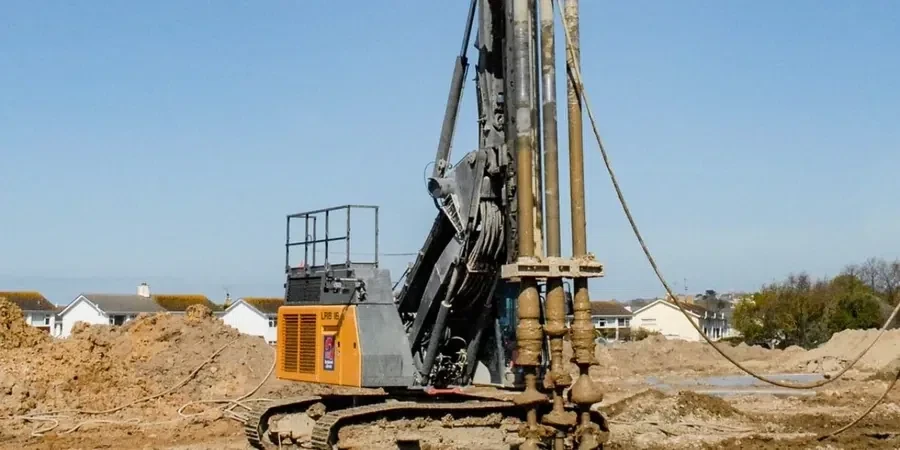
DSM column layout in Middlesbrough must account for sharp lateral transitions in soil stiffness and strength across former industrial fill zones.
Technical details of the service in Middlesbrough
- Undrained shear strength of the natural clay layers (typically 20–60 kPa near the river)
- Organic content and pH of made ground (affects cement hydration)
- Fines content below 63 µm (controls binder penetration)
Critical ground factors in Middlesbrough
Eurocode 7 and the NHBC standards require that any Improvement technique on former industrial land demonstrates long-term durability and no adverse environmental impact. In Middlesbrough, the risk of uncontrolled settlement due to variable fill thickness is high. A poorly designed DSM grid can leave untreated pockets that settle differently from the stabilised columns, leading to differential movement in the structure above. Additionally, leachate from historical contamination may attack the cement binder if the mix is not designed with appropriate sulphate resistance. Our DSM design explicitly models these risks by incorporating partial factors from EC7 and running wet-dry cycling tests on trial columns.
Our services
We offer a full suite of DSM design solutions tailored to Middlesbrough's challenging ground conditions, from initial feasibility through to construction verification.
DSM Feasibility Study
Review of existing borehole logs and trial pit data to determine whether deep soil mixing is technically and economically viable for your Middlesbrough site. Includes binder screening and cost estimate.
Mix Design & Laboratory Trials
Site-specific binder formulation using Middlesbrough soil samples. We test unconfined compressive strength, permeability, and durability under wet-dry cycles to confirm the design mix meets project specifications.
Column Layout & Verification
3D column layout design using finite element analysis to optimise spacing and depth. On-site verification through core sampling and UCS testing of installed columns during production.
Q&A
What is the typical cost range for a DSM design study in Middlesbrough?
For a standard industrial or residential site in Middlesbrough, the design and laboratory trials typically fall between £1.330 and £5.230, depending on the number of soil samples tested and the complexity of the contamination profile. Larger infrastructure projects may exceed this range.
How long does a DSM mix design take for a Middlesbrough project?
The full process from soil sampling to final mix design report usually takes 4 to 6 weeks. The first two weeks are dedicated to laboratory curing of trial columns at 7, 14, and 28 days. We can supply preliminary binder recommendations after 7 days if the construction programme is tight.
Can DSM be used on the soft clays near the River Tees?
Yes. The soft alluvial clays and silts along the Tees corridor respond well to deep soil mixing because of their high moisture content and fine particle size. The key is to use a high-cement binder with a low water/cement ratio to achieve sufficient strength gain within the 28-day curing period.
What QA/QC tests are performed during DSM column installation?
Production columns are verified through wet grab sampling of the mixed material at different depths, followed by UCS testing on cured samples at 7 and 28 days. We also conduct in-situ penetrometer tests on completed columns and compare results against the design target strength. Any column below specification is flagged for supplementary treatment.