Many contractors in Middlesbrough assume a shallow foundation will work until they hit a buried service or a seam of soft clay. That mistake costs time and money. A proper micropile design solves this before you break ground. We assess the local drift geology and the loading requirements first. Then we determine the optimal pile diameter, spacing, and bond length. For sites with restricted headroom or steep slopes, this approach beats driven piles every time. Combining micropile design with a placa de carga test on the capping beam gives you hard data on actual stiffness before the frame goes up. That is how we avoid surprises.
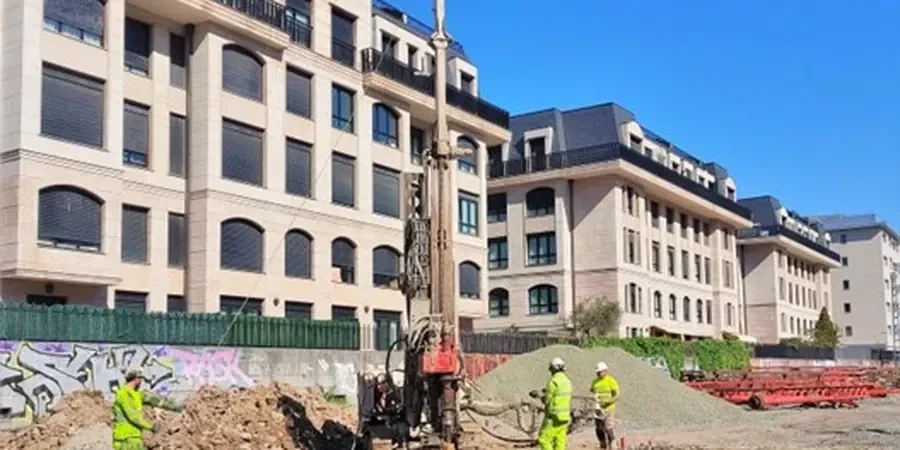
A well-designed micropile in glacial till can carry 300 kN in a 200 mm diameter. That is more than enough for most Middlesbrough extensions.
Technical details of the service in Middlesbrough
Field demonstration
Critical ground factors in Middlesbrough
Middlesbrough sits on glacial till overlying Permian and Triassic sandstones. That sounds stable, but the till contains lenses of silt and soft clay that can cause differential settlement. The water table is often shallow near the River Tees, adding installation risk. A poor micropile design in these conditions leads to excessive grout take or bond failure. We have seen piles that lost 50 % of their capacity because the bond zone was placed in a silt seam. Our design method uses the in-situ SPT N-values and the soil plasticity index to pick a safe bond stress. We also check for sulphate attack on the grout, which is common in the local made ground.
This service complements our laboratory testing work for a complete project analysis.
Our services
We offer two complementary solutions that cover the full micropile workflow in Middlesbrough.
Micropile Load Testing
Static load tests to verify the design bond length and settlement behaviour. We use reaction frames or adjacent piles. Tests follow the Maintained Load Method per BS EN 1997-1 Annex D. Results are reported within 48 hours.
Micropile Installation Supervision
On-site monitoring of drilling parameters, grout density, and pile alignment. We check that the as-built piles match the design assumptions. Daily reports include grout take and refusal criteria.
Q&A
What is the typical cost range for a micropile design in Middlesbrough?
For a standard residential or light commercial project, the design fee ranges between £1.190 and £3.420. This includes the site data review, calculation report, and one revision. Larger projects with multiple load cases may fall outside this range.
How deep do micropiles need to go in Middlesbrough's glacial till?
Bond zones usually start 4 to 8 metres below ground level, depending on the SPT N-values and the presence of soft lenses. We always target a minimum of 3 metres into a consistent stratum. Deeper piles are required near the river where the till is softer.
Can micropiles be installed inside an existing building in Middlesbrough?
Yes. Our low-headroom rigs operate in basements and ground floors with only 2.5 m of vertical clearance. We use sectional casing and a mini grout pump. The entire installation fits through a standard door frame.
What grout strength should be specified for micropiles in this area?
We normally specify a minimum 28‑day cube strength of 40 N/mm². In aggressive ground conditions near the Tees, we increase it to 50 N/mm² and use a sulphate‑resisting cement. The water‑cement ratio is kept below 0.45.
Do I need a structural engineer to review the micropile design?
The design is produced by our chartered geotechnical engineer and covers the geotechnical limit states. A separate structural engineer reviews the connection between the pile head and the foundation beam. We coordinate directly with them to ensure compatibility.