In Middlesbrough, the ground conditions are shaped by glacial till, alluvial deposits, and variable river terrace materials, which is why a soil mechanics study following BS 5930 and Eurocode 7 (EN 1997-1:2004) is essential for any construction project. The city sits on the River Tees, where soft clays and silts alternate with coarse sands and gravels, creating a patchwork of bearing capacities that can shift dramatically within a single site. A thorough investigation — combining boreholes, In-Situ with the SPT, and laboratory classification — provides the data needed to design safe foundations. Without it, the risk of differential settlement or bearing failure is simply too high for structures in this region.
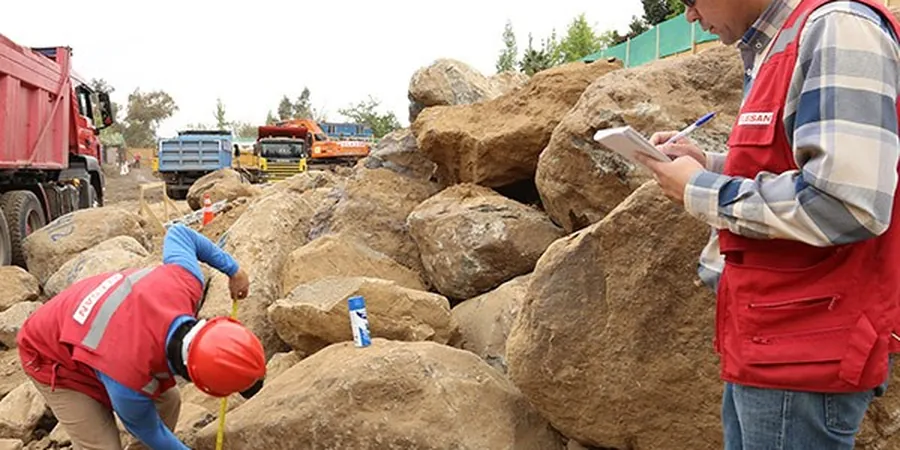
Glacial till and river terrace soils in Middlesbrough can vary by a factor of three in bearing capacity within 50 metres — proper characterisation is non-negotiable.
Technical details of the service in Middlesbrough
Critical ground factors in Middlesbrough
Compare a site in central Middlesbrough, where glacial till provides moderate bearing capacity, with one near the Tees floodplain where soft alluvial clays dominate — the difference in settlement potential can exceed 50 mm. Without a proper soil mechanics study, a foundation designed for stiff till might settle twice as much on soft clay, cracking walls and damaging solutions. Additionally, historic fill from the area's iron and steel industry can contain variable compaction and contamination, requiring careful classification and, where needed, Improvement such as dynamic compaction to mitigate risk.
Our services
Our soil mechanics study in Middlesbrough covers a full suite of field and laboratory solutions to characterise the ground for any project scale.
Borehole Drilling & Sampling
Rotary and windowless sampling boreholes to recover undisturbed U100 tubes and disturbed bag samples, with SPT at regular intervals.
Laboratory Classification
Moisture content, Atterberg limits, particle size distribution, and compaction (Proctor) testing following BS 1377 methods.
Strength & Stiffness Testing
Triaxial compression (UU and CU), direct shear, and oedometer consolidation tests for settlement and bearing capacity analysis.
Geotechnical Interpretative Report
A comprehensive report including ground model, design parameters, foundation recommendations, and slope stability assessment where needed.
Q&A
What is a soil mechanics study and why is it needed in Middlesbrough?
A soil mechanics study characterises the physical and mechanical properties of the ground beneath a site. In Middlesbrough, the mix of glacial till, alluvial clays, and made ground means bearing capacity and settlement behaviour can vary significantly, so the study provides the data needed for safe foundation design.
How long does a soil mechanics study take for a typical residential plot in Middlesbrough?
For a standard residential plot, the fieldwork (boreholes or trial pits) takes one to two days, followed by two to three weeks for laboratory testing and report preparation. Total turnaround is usually three to four weeks.
What is the difference between a soil mechanics study and a site investigation?
A site investigation is the broader process that includes desk study, walkover, and fieldwork. A soil mechanics study focuses specifically on the laboratory testing and geotechnical interpretation of soil samples — it is one component of a full ground investigation.
Does a soil mechanics study include testing for contamination?
Not typically — contamination testing (chemical analysis for hydrocarbons, heavy metals, etc.) is a separate scope. However, we can coordinate both solutions so that samples from the same boreholes are tested for geotechnical and environmental parameters simultaneously.
What is the typical cost range for a soil mechanics study in Middlesbrough?
The cost ranges between £2,340 and £4,610 depending on site access, number of boreholes, depth of investigation, and laboratory test schedule. A detailed quotation is provided after a site-specific scope review.