Middlesbrough's growth along the Tees estuary, from a small farming village into a major industrial port during the 19th century, placed new demands on the surrounding topography. The steep riverbanks and former docklands required engineered slopes to support railways, warehouses and later residential developments. Today, slope stability analysis in Middlesbrough draws on this legacy, combining local geological knowledge with quantitative methods to assess shear strength, pore pressure regimes and potential failure mechanisms. Before any numerical modelling begins, the team completes a detailed site walkover and collects undisturbed samples for laboratory testing; this phase often integrates calicatas exploratorias to inspect stratigraphy directly and ensayo SPT to obtain blow-count profiles at critical locations.
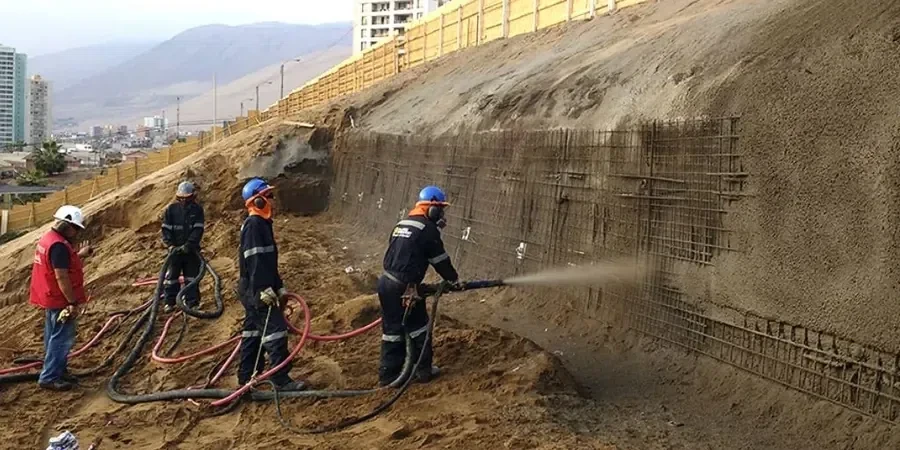
In Middlesbrough's glacial till and alluvial sequences, a 1 m rise in groundwater can reduce the factor of safety by 0.15 to 0.25.
Technical details of the service in Middlesbrough
- Topographic survey with RTK-GNSS to define the slope geometry.
- Installation of standpipe piezometers for pore-water monitoring over at least one wet season.
- Collection of block samples for direct shear and triaxial testing under drained conditions.
Critical ground factors in Middlesbrough
The region's glacial till, interbedded with laminated clays and sands, creates perched water tables that shift rapidly after heavy rainfall. Middlesbrough's annual precipitation exceeds 650 mm, concentrated between October and January, which saturates the upper soil layers and reduces effective stress along potential slip surfaces. This makes slope stability analysis in Middlesbrough particularly sensitive to seasonal pore-pressure variation. Another risk appears in former ironstone workings and colliery spoil tips on the southern outskirts, where loose fill and metastable fabric can trigger retrogressive failures if the toe is undercut or loaded without assessment.
Our services
We offer two complementary solutions for clients planning cuts, fills or retaining structures in the Middlesbrough area.
Limit-Equilibrium Slope Assessment
Two-dimensional analysis using Bishop, Spencer and Morgenstern-Price methods. Includes sensitivity runs for groundwater variation, surcharge loads and seismic coefficient. Output includes factor of safety contours and critical slip surface identification.
Finite-Element Stability Modelling
Advanced stress-strain analysis with PLAXIS 2D. Suitable for complex geometries, progressive failure and soil-structure interaction. Reports include displacement vectors, shear strain contours and strength reduction factors.
Q&A
What is the typical factor of safety required for a permanent slope in Middlesbrough?
For long-term drained conditions under Eurocode 7 Design Approach 1, a minimum factor of safety of 1.30 is generally specified. Temporary cuts may be designed to 1.20, while slopes adjacent to existing structures or roads often require 1.40 or higher depending on the consequence class.
How does the glacial till in Middlesbrough affect slope behaviour?
The glacial till is typically a stiff, overconsolidated clay with occasional sand lenses. Its fissured structure and high clay fraction (30-50 percent) can lead to progressive softening along pre-existing discontinuities. Pore-water pressure buildup within the sand lenses is a common trigger for delayed failures, especially after prolonged rainfall.
What is the cost range for a slope stability study in this area?
A standard slope stability analysis for a single section, including site visit, laboratory testing and a summary report, falls between £930 and £3.320. The final cost depends on the number of cross-sections, complexity of groundwater regime and required testing scope.
Can slope stability analysis be performed for small residential developments?
Yes. Even single-plot developments on sloping ground benefit from a basic assessment. A desk study combined with two trial pits and simple limit-equilibrium analysis can confirm that the proposed cut or fill does not reduce the factor of safety below acceptable limits. This is often required by local planning conditions.