We follow BS 5930 and Eurocode 7 (EN 1997-1:2004) to deliver SPT (Standard Penetration Test) investigations across Middlesbrough. The city sits on a mix of Glacial Till, alluvial deposits along the River Tees, and made ground from its industrial past — each requiring its own approach to sampling and N-value correlation. Our team has been running SPT boreholes here for years, and we know exactly where the drift cover thickens and where bedrock comes close to the surface. Before we start, we often review existing borehole records from the British Geological Survey to refine our plan. For projects on reclaimed land near the docks, we frequently combine SPT with a placa de carga to validate bearing capacity directly under working loads.
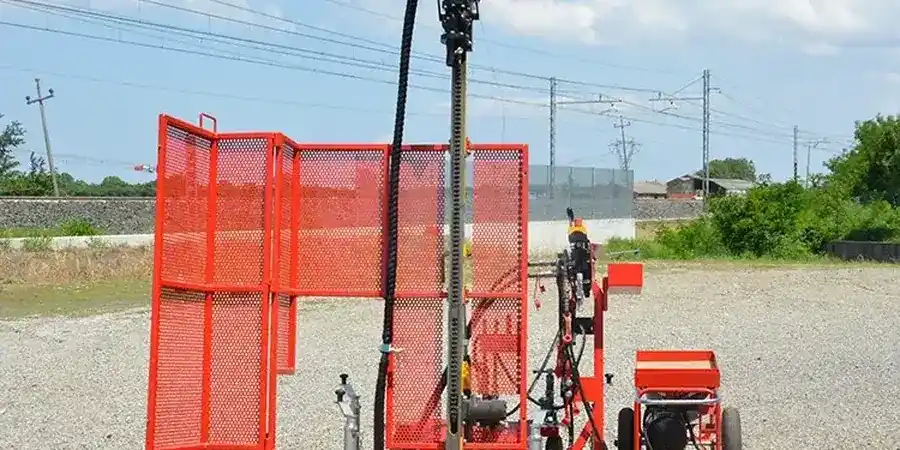
We log N-values from 8 blows in soft till to over 60 in weathered sandstone — each test follows BS EN ISO 22476-3 with energy transfer verification.
Technical details of the service in Middlesbrough
Field demonstration
Critical ground factors in Middlesbrough
Glacial Till across central Middlesbrough usually gives N-values between 15 and 35, which is fine for conventional shallow foundations. But along the river corridor, soft alluvial clays and peat can drop to N-values below 5, especially near Newport Bridge and Middlehaven. In those zones, the risk of differential settlement is real, and SPT data alone may not be enough — we often recommend additional dissipation testing or a estudio de licuefacción when loose saturated sands are present. Ignoring these local variations has led to cracked floor slabs and tilted retaining walls in past developments here.
Our services
Our SPT service covers the full workflow from mobilisation to factual reporting, with two core options tailored to Middlesbrough ground conditions.
Borehole SPT with Continuous Sampling
We drill rotary boreholes to depths up to 30 m, recovering undisturbed and disturbed samples alongside SPT at each metre. This service suits multi-storey buildings or infrastructure projects where you need both stratigraphy logs and strength profiles. Our reports include corrected N-values, soil classification per BS 5930, and a summary of groundwater strikes.
Targeted SPT for Shallow Foundations
For smaller schemes — house extensions, garage blocks, retaining walls — we run targeted SPT boreholes to 8–12 m depth, focusing on the bearing stratum. We supply N-value plots, estimated allowable bearing pressure based on Terzaghi and Eurocode 7, and a clear recommendation on foundation type. Turnaround is typically 5 working days from field completion.
Q&A
What is the typical cost range for an SPT investigation in Middlesbrough?
For a standard borehole with SPT at 1.5 m intervals to 15 m depth, including mobilisation, sampling, and a factual report, you should budget between £420 and £600 per borehole. Prices vary with access conditions, number of tests, and whether you need disturbed or undisturbed samples. We supply a fixed quote after a quick site walkover.
How do N-values from SPT relate to bearing capacity for Teesside soils?
We apply Terzaghi's bearing capacity factors and Eurocode 7 partial factors to correlate N-values with allowable bearing pressure. In Middlesbrough's Glacial Till, N-values of 15–35 typically yield allowable pressures of 100–250 kPa. In soft alluvium along the Tees, N-values below 5 translate to very low capacities, often requiring deep foundations or Improvement.
At what depth should SPT stop in Middlesbrough bedrock?
We generally stop SPT when we reach weathered sandstone or mudstone with N-values exceeding 50 for three consecutive tests, and we have at least 1.5 m of rock core to confirm the horizon. In central Middlesbrough, bedrock is often encountered between 8 and 15 m depth. Refusal is defined as 50 blows for less than 75 mm penetration, which we report with the hammer energy record.