A recent industrial yard near the River Tees required Improvement for a 15-tonne slab load, and the client chose dynamic compaction over deep piling. The site had 4 m of made ground over soft alluvium, a typical profile for Middlesbrough’s old docklands. We designed the drop pattern and energy level based on trial passes, measuring crater depth and post-treatment plate tests. Before the main programme, we ran a plate load test to verify the required bearing capacity and correlated results with CPT logs. The operation used a 12‑tonne weight dropped from 18 m on a 4 m grid, achieving 95 % of the target modulus in two passes. The project finished on schedule and saved the developer 40 % compared to driven piles.
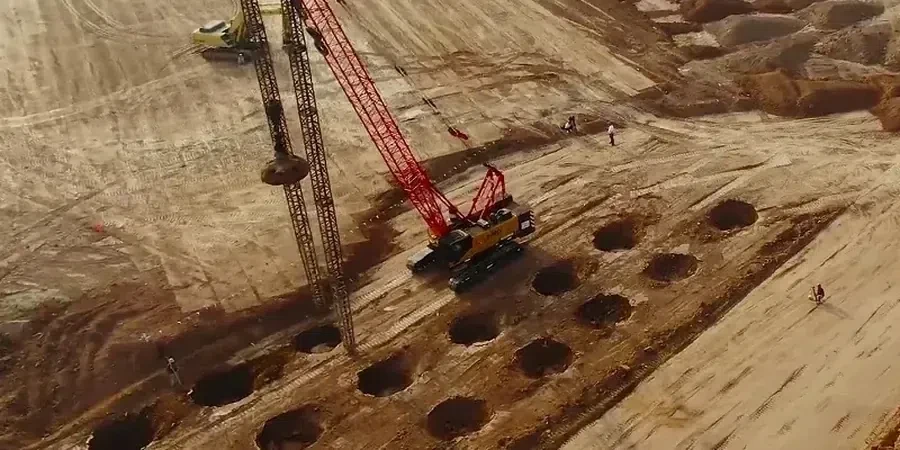
Dynamic compaction design in Middlesbrough relies on matching tamper energy to the fill type — coal shale and ash react differently than clayey alluvium.
Technical details of the service in Middlesbrough
Critical ground factors in Middlesbrough
A 12‑tonne tamper hanging from a 20 m crane creates ground vibration that can affect adjacent buildings — in Middlesbrough’s terraced streets this is a real concern. We always install vibration monitors on party walls and set a peak particle velocity limit of 12 mm/s to stay within BS 7385 thresholds. The design must also avoid over‑densification in silty layers, which can turn them brittle. On a recent housing site near the town centre we reduced the drop height to 15 m to protect a Victorian sewer running 3 m below. The sequence was programmed in two phases with a 48‑hour rest period to allow pore‑pressure dissipation.
This service complements our laboratory testing work for a complete project analysis.
Our services
We tailor the compaction design to your site’s specific fill history and target bearing pressure.
Dynamic compaction trial programme
A controlled test area with instrumented drops to calibrate energy, grid spacing and number of passes before full‑scale treatment. Includes crater survey, plate load tests and CPT verification.
Full‑area compaction design & supervision
Production drops following the approved grid, with real‑time crater monitoring and vibration control. We issue a compliance report showing modulus achieved versus design target.
Q&A
How much does dynamic compaction design cost in Middlesbrough?
For a typical industrial plot in Middlesbrough the design and supervision fee ranges from £890 to £3,420, depending on site area, number of trial passes and post‑treatment testing scope. A full turn‑key package including crane hire and testing may cost more.
What depth of improvement can be achieved with dynamic compaction in Teesside fills?
In granular fills common around Middlesbrough — such as colliery shale, ash and demolition rubble — improvement depths of 4 m to 7 m are achievable with a 15‑tonne tamper. The actual depth depends on the material’s particle size and the energy per drop.
Can dynamic compaction be used near existing buildings in central Middlesbrough?
Yes, but the design must include vibration monitoring and reduced drop heights for the first pass. We routinely work within 5 m of occupied structures by limiting peak particle velocity to 12 mm/s and using a staggered drop sequence to control vibration directivity.