The heavy clay soils around Middlesbrough, shaped by glacial deposits and the Tees estuary, present a real challenge for any construction project. When you're dealing with saturated, low-permeability ground that takes years to settle naturally, a well-designed prefabricated vertical drain system becomes the practical solution. We have designed PVD arrays for industrial plots along the Teesport corridor where the water table sits barely a metre below the surface. The idea is straightforward: accelerate consolidation by shortening the drainage path. Before we specify drain spacing or pattern, we always run a permeability field test to confirm the horizontal coefficient of consolidation in the actual ground conditions. That single number drives the whole design.
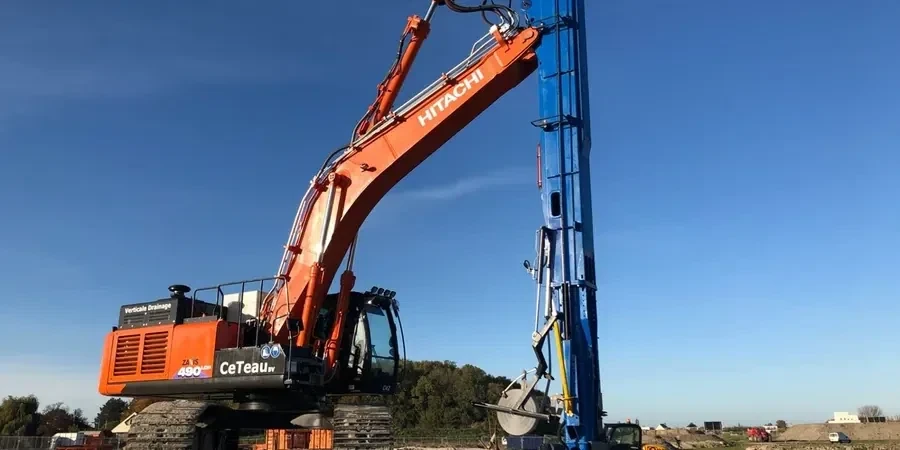
A properly designed PVD system can reduce consolidation time from years to months, turning unbuildable soft ground into a stable platform for development.
Technical details of the service in Middlesbrough
- Spacing and depth of prefabricated vertical drains
- Equivalent drain diameter and smear zone effect
- Horizontal coefficient of consolidation from field testing
- Estimated time to target degree of consolidation
Critical ground factors in Middlesbrough
The biggest risk in Middlesbrough's soft ground is underestimating the smear effect during PVD installation. When the mandrel pushes through the clay, it remoulds a zone around each drain, reducing horizontal permeability by up to an order of magnitude. We have seen designs fail because engineers assumed undisturbed ch values from oedometer tests. Another frequent issue is clogging of the filter sleeve in the fine-grained Tees estuary clays. Our approach is to run a trial installation with three different mandrel sizes, then retrieve drain samples for laboratory inspection. Only after verifying the filter performance do we approve the full production layout.
Our services
We offer a complete PVD design package tailored to Middlesbrough's ground conditions, from initial site investigation through to construction monitoring.
PVD spacing and depth optimisation
Using Barron's and Hansbo's methods calibrated with site-specific ch values, we determine the optimal drain spacing and depth to meet your project's consolidation timeline. We supply detailed layout drawings and installation specifications.
Preloading and staged construction design
We design the surcharge fill height and staging sequence to work in tandem with the PVD array, ensuring stability during construction and achieving the target post-construction settlement within the programme.
Performance monitoring and verification
We install settlement plates, piezometers, and inclinometers to track consolidation progress in real time. Monitoring data is compared against the design predictions, allowing adjustments to surcharge duration if needed.
Q&A
How long does a typical PVD design take for a Middlesbrough site?
From receiving the ground investigation data, a preliminary PVD design with spacing and depth recommendations usually takes 5 to 10 working days. If we also need to run field permeability tests or install trial drains, add another 2 to 3 weeks depending on site access.
What is the typical cost range for a prefabricated vertical drain design in Middlesbrough?
For a standard commercial or industrial plot, the design fee typically falls between £590 and £1,840. This covers the initial assessment, parameter selection, spacing calculations, and a design report. Larger sites with variable ground conditions or phased construction may be quoted separately.
Can PVDs be used for residential developments on Teesside clay?
Yes, absolutely. We have designed PVD systems for several housing developments in the Middlesbrough area where the top 6 to 8 metres consist of soft to firm clay. The drains are typically installed at 1.5 to 2.0 metre spacing with a preload embankment, allowing the ground to consolidate before foundation construction begins.
What happens if the smear zone is worse than assumed in the design?
We always include a sensitivity analysis in our design report, showing how consolidation time changes with higher smear ratios. If field monitoring reveals slower drainage than predicted, we can recommend additional measures such as closer drain spacing on part of the site or extending the surcharge period.