Middlesbrough sits on a complex mix of glacial till, alluvial sands, and river terrace deposits from the Tees. The water table here often fluctuates seasonally, especially near the river corridor. In our background, conventional grouting alone can struggle to produce consistent columns in these variable ground conditions. That is why we apply a structured jet grouting design methodology tailored to Middlesbrough's geology. Before specifying the jet parameters, we always review the site's soil stratification and groundwater regime. A proper ground model helps us determine the optimal cutting pressure, flow rate, and rod withdrawal speed. When the target is a low-permeability barrier, we also check the deep soil mixing approach as an alternative for cohesive layers.
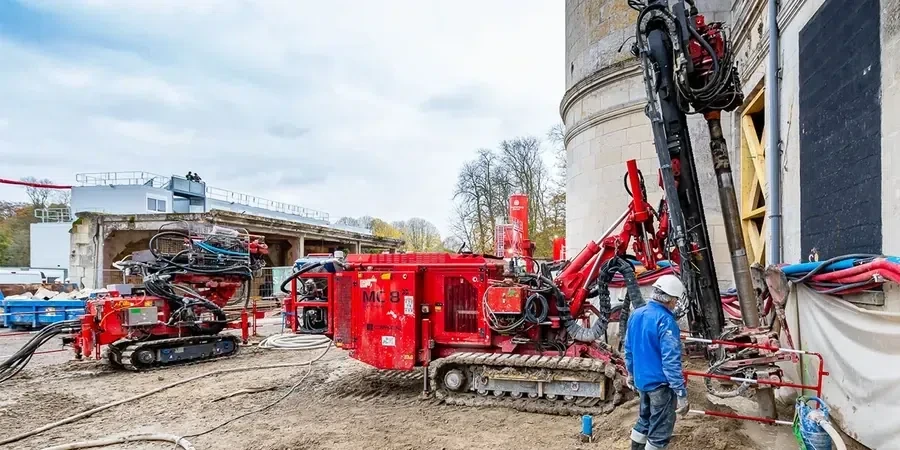
Jet grouting design must account for Middlesbrough's variable glacial till and alluvial sands to achieve consistent column geometry and strength.
Technical details of the service in Middlesbrough
Critical ground factors in Middlesbrough
Middlesbrough's population is around 140,000, and the urban area has seen significant redevelopment on brownfield land. Old foundations, buried obstructions, and variable fill thickness pose real risks for jet grouting design. If the cutting jet encounters a buried concrete slab or steel pile, the column may be incomplete or deviated. We always recommend a pre-construction utility and obstruction survey alongside the jet grouting design. That way, the nozzle trajectory and energy settings can be adjusted in advance. In our background, these proactive measures reduce unplanned downtime and prevent costly remediation later.
This service complements our laboratory testing work for a complete project analysis.
Our services
We offer three core jet grouting design solutions adapted to Middlesbrough's ground conditions.
Single Fluid Jet Grouting Design
For cohesive soils and moderate column diameters up to 1.0 m. We calibrate injection pressure and grout mix to Middlesbrough's glacial till layers.
Double Fluid Jet Grouting Design
Uses compressed air shroud to extend cutting radius. Suitable for alluvial sands and silts common near the Tees. Column diameters reach 1.8 m.
Triple Fluid Jet Grouting Design
Separate air, water, and grout injection for maximum diameter (up to 2.5 m) and lowest permeability. Applied when groundwater control is critical in Middlesbrough.
Q&A
How much does jet grouting design cost in Middlesbrough?
For a typical Middlesbrough project, the design fee ranges between £1,500 and £5,390, depending on the complexity of the ground model and the number of trial columns needed. This includes site-specific parameter selection and verification testing.
What ground conditions affect jet grouting design in Middlesbrough?
Middlesbrough's glacial till contains cobbles and boulders that can deflect the jet. Alluvial sands may cause washout if the grout mix is not adjusted. We always review borehole logs and groundwater data before finalising the design.
How do you verify column diameter and strength after jet grouting?
We use trial columns with coring and unconfined compressive strength testing. For Middlesbrough sites with sensitive structures, we also apply the placa de carga test to measure stiffness directly.
Can jet grouting design be combined with other Improvement methods?
Yes. In Middlesbrough we often combine jet grouting with deep soil mixing or drenes verticales when dealing with very soft alluvium. The design is adapted to achieve both strength and drainage requirements.
What is the typical timeline for a jet grouting design in Middlesbrough?
A standard design package takes 2 to 4 weeks, including site data review, parameter selection, and a preliminary column layout. If trial columns and testing are required, add 1 to 2 weeks depending on site access.