Middlesbrough grew rapidly in the 19th century on the back of iron and steel. The town sits on a mix of glacial till, alluvial deposits from the River Tees, and made ground from industrial activity. That legacy means variable compaction and frequent buried obstructions. Our grouting design addresses these inconsistencies directly. We assess void risk, permeability, and load-bearing capacity before specifying injection parameters. Before any treatment begins, we always run a permeability field test to calibrate the grout mix, and a borehole SPT to map strength profiles across the site. This phased approach avoids wasted material and ensures the grout reaches the intended zone every time.
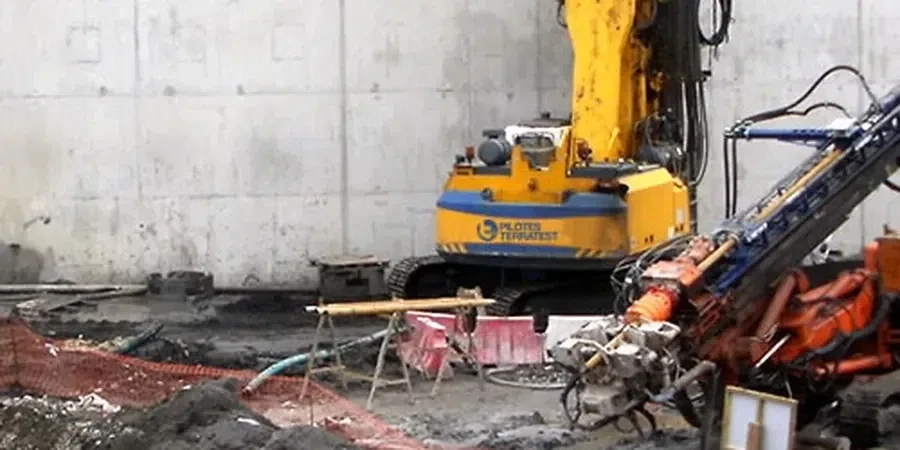
Grouting without a prior permeability test is guesswork. We calibrate every mix to the actual ground conditions in Middlesbrough.
Technical details of the service in Middlesbrough
- Grout pressure and flow rate to avoid hydrofracture
- Water-cement ratio and additive dosage
- Spacing and pattern of injection points
- Post-treatment verification via coring and permeability tests
Critical ground factors in Middlesbrough
Compare a site in central Middlesbrough, where made ground from demolished ironworks is common, with a greenfield site on the southern edge near Marton. The former may have high void ratios and unknown chemical residues; the latter tends toward stiff boulder clay with low permeability. A grouting design that works in one will fail in the other. We always tailor the mix design, injection sequence, and pressure limits to the specific contamination risk and soil structure found on each plot. Ignoring these local differences leads to incomplete sealing and wasted material.
Our services
We offer two core grouting design solutions, both backed by in-house laboratory testing and field verification.
Permeation Grouting Design
For granular soils and fissured rock in Middlesbrough, we design low-pressure permeation grouting to fill voids without disturbing the soil structure. We specify grout viscosity, gel time, and injection layout to achieve uniform penetration. Post-treatment coring and Lugeon testing confirm sealing effectiveness.
Compaction Grouting Design
When loose fill or made ground requires densification, we design compaction grouting with low-slump, high-friction mortar. Injection points are arranged in a grid, with staged lifts to avoid heave. We monitor ground response in real time and adjust the sequence based on pressure and volume data.
Q&A
What does grouting design cost in Middlesbrough?
For a typical residential or small commercial site in Middlesbrough, grouting design fees range from £1,050 to £3,780 depending on site complexity, number of injection points, and verification testing required. Final cost is confirmed after the site investigation phase.
How long does a grouting design take to complete?
Once we have borehole logs and lab results, the design report is usually ready within 5 to 10 working days. If field trials are needed, add another week for execution and analysis.
What ground conditions in Middlesbrough require grouting?
Sites with made ground, old foundations, or high groundwater flow benefit most. Alluvial deposits along the Tees often need permeation grouting to control seepage, while Victorian-era fill on former industrial plots responds well to compaction grouting.
Do you provide on-site supervision during grouting works?
Yes. Our team supervises trial panels and production injection, adjusting parameters in real time. We also coordinate with the contractor on pressure limits, volume recording, and post-treatment verification to meet the design specification.