Middlesbrough's position along the River Tees, with its thick deposits of glacial till overlying Mercia Mudstone, creates a specific challenge for deep foundation design. The variable depth to rockhead and the presence of buried channels mean that a generic pile solution rarely works. In our background, a successful driven pile design in Middlesbrough starts with a thorough understanding of the soil profile, often requiring a combination of rotary core drilling and careful interpretation of the drift geology. Before finalizing the pile layout, we routinely integrate data from a calicatas exploratorias programme to confirm stratum boundaries across the site, ensuring that the pile toe reaches a competent bearing stratum without excessive over-design.
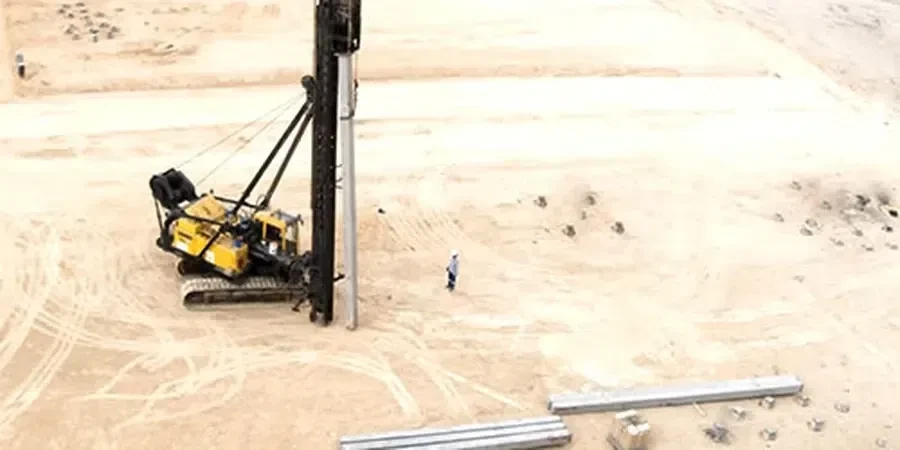
For Middlesbrough's variable glacial till, a staged investigation combining rotary cores and SPT data is the only way to deliver a reliable driven pile design.
Technical details of the service in Middlesbrough
Critical ground factors in Middlesbrough
The hydraulic hammer used for driving piles in Middlesbrough's urban areas must be carefully sized to avoid excessive noise and vibration near existing structures like the Transporter Bridge or Victorian terraces. We specify a low-vibration hydraulic hammer with a variable stroke, and we always run a preliminary wave equation analysis to predict driving stresses. Monitoring the pile set during the final driving phase is non-negotiable. In the soft ground near the river, we also check for negative skin friction if the piles pass through a layer of compressible alluvium that could settle under fill surcharge.
Our services
We supply three complementary solutions to support a solid driven pile design in Middlesbrough, from initial site investigation through to final pile load testing.
Ground Investigation for Piling
Rotary core drilling with SPT and sampling, plus CPT profiling in the glacial till to define shaft friction and end-bearing parameters directly. Includes borehole logs and laboratory index tests on intact rock cores.
Pile Design and Verification
Calculation of design axial capacity in compression and tension using Eurocode 7 Design Approach 1, with static formulae and wave equation analysis. We also produce a pile installation specification for the contractor.
Pile Load Testing Supervision
On-site supervision of static load tests to verify the design assumptions. We interpret the load-settlement curve to confirm the geotechnical ultimate limit state and supply a test report for the structural engineer.
Q&A
What soil conditions affect driven pile design in Middlesbrough?
Middlesbrough's ground is dominated by glacial till, which can be very dense but also contains soft lenses. The Mercia Mudstone bedrock is generally strong, but its depth varies. A good design must account for these local variations.
How much does a driven pile design study cost in Middlesbrough?
For a typical residential development, the design study including a site visit and a short report ranges from £1,130 to £3,090. Larger industrial projects with multiple pile types will be at the upper end of this range.
What is the difference between a driven pile and a bored pile?
A driven pile is a prefabricated member (concrete or steel) hammered into the ground, displacing the soil. A bored pile is cast in place after drilling a hole. Driven piles are often faster and more economical in granular soils, while bored piles are preferred in cohesive soils where vibration is a concern.
Do you provide a pile installation specification?
Yes. After the design, we produce a specification that includes the required set, the hammer energy, and the refusal criteria. This document is essential for the contractor and for quality control during piling.