Middlesbrough's industrial heritage, centred on the River Tees, shaped a landscape where reclaimed land and river terrace deposits dominate the subsurface. The town expanded rapidly during the 19th and 20th centuries, with much of its infrastructure built over alluvial clays and made ground from steelworks and shipbuilding. For any compaction project on these variable fills, the field density test (sand cone method) provides the most direct measure of achieved density. Before placing structural fill, a plate load test often complements the sand cone results to verify bearing capacity under controlled loading. Our team has performed hundreds of these tests across Middlesbrough, from the Teesport area to the new housing developments in Coulby Newham, where glacial till overlies laminated clays.
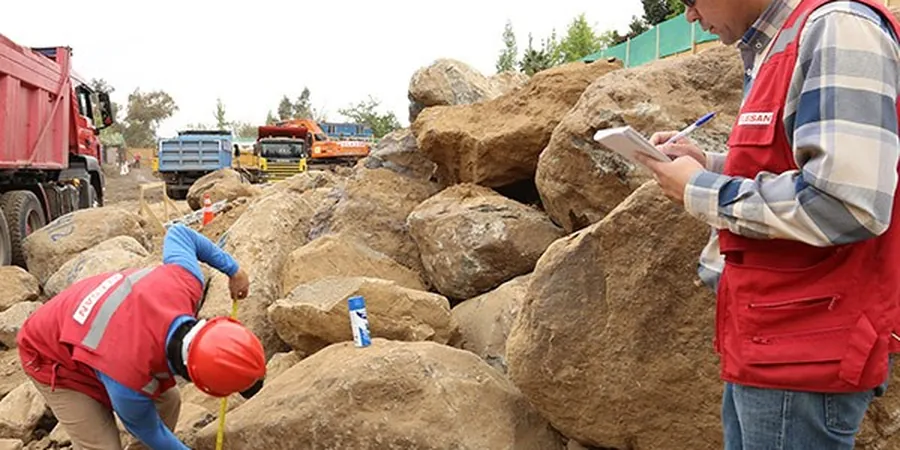
A single sand cone test on Teesside slag fill revealed dry density 8% below Proctor optimum, preventing premature road settlement.
Technical details of the service in Middlesbrough
- Bulk density and dry density of the compacted layer
- Moisture content by oven drying (BS 1377-2:1990)
- Relative compaction compared to Proctor maximum (BS 1377-4:1990)
- Degree of saturation for fine-grained soils
Critical ground factors in Middlesbrough
A contractor on a new retail park off Marton Road once relied solely on nuclear gauge readings for compaction control. The gauge reported 98% of Proctor density, but a subsequent sand cone test on the same layer showed only 89%. The discrepancy was traced to high moisture content in the clayey sand, which the nuclear gauge overestimated due to hydrogen interference. Without the sand cone check, the pavement subbase would have settled unevenly within six months, leading to cracked slabs and costly remedial work. This is why we insist on the sand cone method as the primary verification tool for every compaction layer in Middlesbrough.
Our services
We offer a complete suite of compaction control solutions across Middlesbrough, tailored to the local ground conditions and project scale.
Standard Sand Cone Test
Full procedure per BS 1377-9:1990, including pit excavation, sand cone placement, and laboratory moisture content determination. Suitable for granular fills, slag, and crushed rock.
Nuclear Gauge Calibration Cross-Check
Where speed is needed, we run side-by-side nuclear gauge and sand cone tests to establish site-specific correlation factors, ensuring the gauge readings remain reliable.
Compaction Trial Strip Monitoring
For large earthworks projects in Middlesbrough, we monitor trial strips at varying roller passes and moisture levels, using sand cone tests to define the compaction specification.
Q&A
What is the sand cone test and how does it work?
The sand cone test determines the in-situ density of a compacted soil layer by excavating a small test pit, weighing the removed material, and filling the hole with calibrated sand of known density. The volume of the hole is derived from the mass of sand used, and dry density is calculated after moisture content correction.
How much does a field density test cost in Middlesbrough?
A single sand cone test typically costs between £80 and £120, depending on site access, number of tests per day, and whether moisture content determination is included. Volume discounts apply for larger earthworks projects.
What is the difference between sand cone and nuclear gauge density?
The sand cone method directly measures density by mass and volume, making it the reference standard for compaction control. Nuclear gauges use backscatter radiation and require site-specific calibration. In wet or clay-rich soils, nuclear readings can be 5-10% higher than actual density, so we always recommend sand cone verification.
How deep can the sand cone test measure?
Standard tests measure the top 100-150 mm of a compacted lift, which corresponds to the typical thickness of a single roller pass. For deeper verification, multiple tests are performed on successive lifts during construction.
What moisture content is acceptable for compaction in Middlesbrough?
The target moisture content is usually within ±2% of the Proctor optimum (BS 1377-4). Given Middlesbrough's rainfall, we often see fills at 3-5% above optimum, which reduces achievable density. In these cases, we recommend aeration or lime treatment before re-compaction.