The contrast between the firm glacial tills found beneath central Middlesbrough and the soft alluvial clays along the Tees estuary is striking. In areas like Newport or Middlehaven, where reclamation and river deposits dominate, the undrained shear strength of the ground can drop below 20 kPa near the surface. That is precisely where the field vane shear test becomes indispensable. Instead of relying solely on empirical correlations from SPT blow counts in soft soils—which tend to be unreliable—we measure the in-situ strength directly. For sites where excavation is difficult or where sample disturbance is a concern, complementing the vane test with a plate load test gives a cross-check on bearing capacity under working loads.
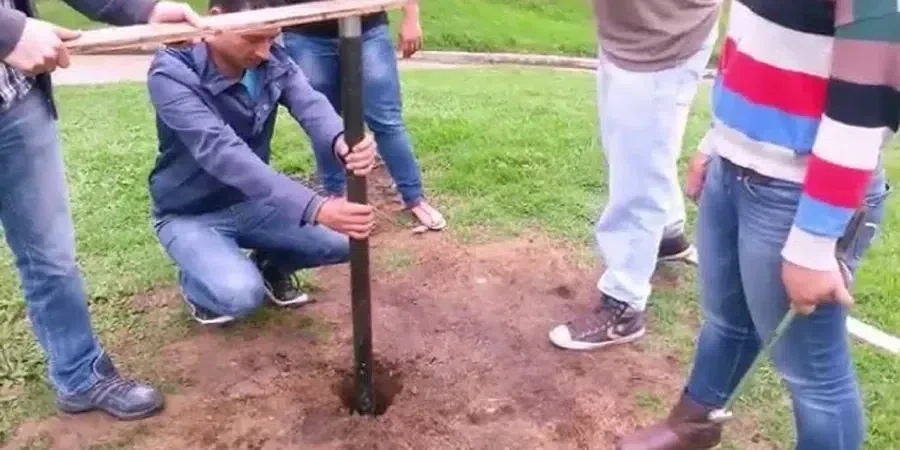
In the soft clays of the Tees floodplain, the vane shear test provides the most direct measure of undrained strength, free from sample disturbance errors.
Technical details of the service in Middlesbrough
Field demonstration
Critical ground factors in Middlesbrough
The soft alluvial clays and organic silts beneath Middlesbrough’s riverside districts are prone to significant strength loss under cyclic loading—think of the vibrations from piling or heavy compaction nearby. We have seen cases in the Riverside Park development where the sensitivity ratio exceeded 6, meaning the remoulded strength dropped to less than one-sixth of the peak value. That behaviour, if missed, can lead to progressive failure in embankments or excessive settlement under shallow foundations. The vane shear test catches this by measuring both peak and remoulded torque, giving us the sensitivity index that informs whether a site needs Improvement or a piled solution.
Our services
We offer two complementary vane shear testing solutions tailored to the ground conditions typical of the Teesside area.
Standard Field Vane Shear Test (VST)
In-situ measurement of undrained shear strength using a four-bladed vane advanced from a drill rod. Full torque recording at peak and remoulded states. Suitable for soft to firm clays and silts. Delivered with a factual report including correction factor µ and sensitivity ratio.
Deep Vane Shear Testing in Boreholes
Vane testing carried out below the base of a pre-bored hole, typically after SPT sampling or coring. Allows assessment of strength at depths up to 30 m, with continuous torque logging. Ideal for multi-layer profiles where the soft clay extends well below the surface.
Q&A
How does the field vane shear test differ from a laboratory triaxial test?
The vane test measures undrained shear strength directly in the ground, avoiding sample disturbance that can reduce lab triaxial results by 20–40% in soft clays. It gives a quick in-situ value under natural stress conditions, whereas the triaxial test controls drainage and stress paths but requires undisturbed sampling.
What is the typical cost range for a vane shear test in Middlesbrough?
For a standard single-point vane test in the Middlesbrough area, the cost is between £480 and £1,190 depending on depth, number of test points, and site access. A full investigation with multiple depths and reporting will be at the higher end of that range.
Which correction factor should be applied to vane test results in Teesside clays?
We apply the Bjerrum (1972) correction factor µ, which depends on the plasticity index (PI). For the soft alluvial clays of the Tees floodplain, where PI typically ranges from 35–55%, µ falls between 0.85 and 0.70. This adjustment accounts for the effect of strain rate and anisotropy on the measured strength.
Can the vane shear test be performed in stiff clays or sandy soils?
The vane is designed for fine-grained soils with undrained shear strength below about 200 kPa. In stiff clays or dense sands, the torque required may exceed the vane capacity or cause rod failure. For such soils, we recommend a pile load test or SPT instead.
How long does a vane shear test take on a typical Middlesbrough site?
A single vane test at one depth, including setup, vane insertion, torque measurement, and retrieval, takes about 30–45 minutes. For a borehole with tests every 1 m down to 10 m, expect a full day on site. We coordinate with the drilling crew to minimise downtime.