We were called to a site near the River Tees where a new storage yard was planned on soft alluvial clays. The client needed to accelerate settlement before placing the floor slabs. That is where preloading with surcharge design comes in. We designed a staged fill program using local granular fill as surcharge, monitoring pore pressure dissipation with piezometers. For that particular project, combining the preload with vertical drains cut the consolidation time from months to weeks. Middlesbrough has plenty of these low-lying sites where the water table sits high and the clay is soft. Getting the preload geometry right is key to avoiding long-term differential settlement under the final load.
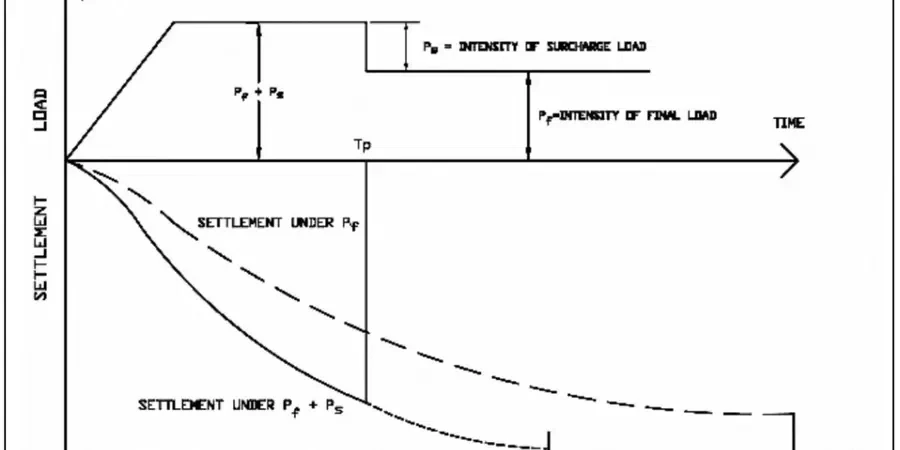
A staged preload with proper drainage and monitoring can cut settlement time by half on Middlesbrough's soft alluvial clays.
Technical details of the service in Middlesbrough
Critical ground factors in Middlesbrough
The biggest risk we see in Middlesbrough is underestimating the settlement from secondary compression in the alluvial clay. Even after primary consolidation finishes, the soil keeps creeping under sustained load. If the surcharge is removed too early, the floor slabs will settle unevenly a year later. We always set a minimum pore pressure dissipation target of 90 percent and leave monitoring plates in place for at least three months after removal. Another risk is lateral displacement under the preload edges. On tight sites next to existing structures, we sometimes use a reinforced fill berm or a sheet pile wall to contain the fill. Missing the presence of peat lenses is also common — a single borehole can miss a pocket of peat that will compress twice as much as the clay around it.
This service complements our laboratory testing work for a complete project analysis.
Our services
We offer two core solutions for preloading with surcharge design in Middlesbrough, each tailored to the local ground conditions and project constraints.
Preload Design and Monitoring
We design the staged fill programme, calculate the required surcharge height, and specify the instrumentation. On site we install settlement plates, piezometers, and inclinometers to track performance in real time.
Consolidation Testing and Analysis
We run oedometer tests on undisturbed samples to determine compression index, recompression index, and coefficient of consolidation. The lab data feeds directly into the settlement model for the preload design.
Q&A
How long does preloading with surcharge typically take in Middlesbrough?
It depends on the clay thickness and drainage conditions. For a 3-metre fill on 6 metres of soft alluvial clay, we usually budget 4 to 8 months of preload time. With vertical drains that drops to 2 to 4 months. We always monitor pore pressure dissipation to confirm when the surcharge can be removed.
What is the typical cost range for a preloading with surcharge design in Middlesbrough?
For a standard design including lab testing, instrumentation, and monitoring over six months, the cost ranges between £680 and £2,180. The final figure depends on site access, fill availability, and the number of monitoring points required.
Can preloading with surcharge be used on brownfield sites in Middlesbrough?
Yes, but we need to check for buried obstructions, old foundations, and contamination first. The fill must be clean granular material, and we often run a plate load test after preload removal to verify the bearing capacity before the floor slab is poured. Brownfield sites also require a gas monitoring strategy during the preload period.