A recent project on Wilson Street required a 4-metre-high cantilever wall to support a new basement excavation, with the adjacent Victorian terraces sitting less than two metres from the cut line. The ground here is typical of Middlesbrough's alluvial plain: soft clays and silty sands overlying glacial till, with the water table often encountered within 1.5 metres of the surface. For that job we combined detailed soil strength data from borehole SPT testing with groundwater monitoring to calibrate the active and passive pressure coefficients. Getting the design right in these conditions is not just about stability under static loads; it is about anticipating how the wall will behave during the construction sequence and over its 50-year service life.
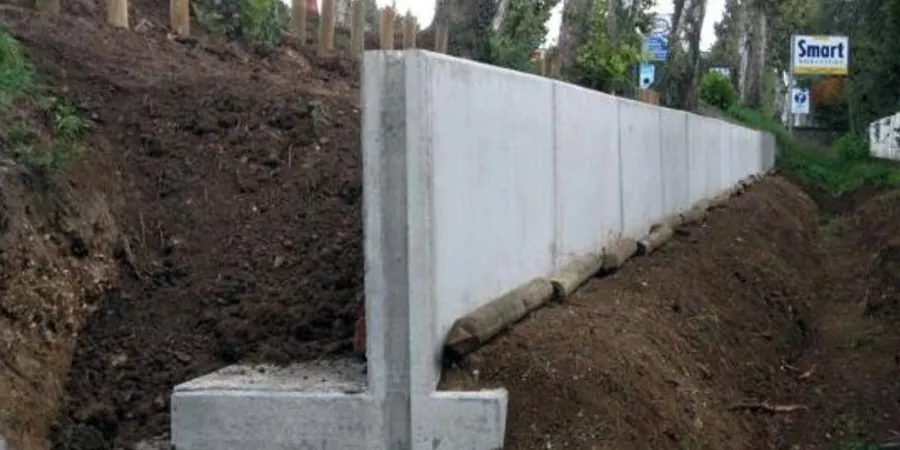
In Middlesbrough's alluvial clays, the short-term undrained strength often controls the wall design — not the drained parameters engineers assume from textbook values.
Technical details of the service in Middlesbrough
Critical ground factors in Middlesbrough
In Middlesbrough, one recurring issue we see is the presence of buried industrial foundations and old drainage runs from the town's iron and steel era. A retaining wall design that does not account for these obstructions can lead to unexpected delays, excavation collapses, or even a change in wall type halfway through the job. The other common risk is underestimating the softened zone behind the wall caused by seasonal wetting and drying of the clay. We always recommend a minimum factor of safety of 1.3 against sliding under drained conditions, and we check the bearing pressure at the toe using the actual foundation width rather than relying on a nominal value from a desk study.
Our services
Our retaining wall design service covers the full scope from concept to detail, tailored to Middlesbrough's ground conditions and local planning requirements.
Gravity & cantilever walls
Reinforced concrete cantilevers and mass gravity walls for heights up to 5 m, designed with or without a toe key depending on the bearing capacity of the underlying glacial till.
Embedded retaining walls (sheet piles / secant piles)
Steel sheet piles and secant piled walls for deep basements and riverfront sites, with structural design to Eurocode 7 and groundwater control measures included in the stability assessment.
Soil nailing & anchored walls
Temporary or permanent soil nailed walls for steep cuts and slope stabilisation, using galvanised bars and shotcrete facing with full corrosion protection for the Tees Valley environment.
Reinforced soil & MSE walls
Mechanically stabilised earth walls with geogrid or steel strip reinforcement for embankments and bridge approaches, designed to BS 8006-1:2010 and verified with slope stability software.
Q&A
What is the typical cost range for retaining wall design in Middlesbrough?
For a standard residential basement wall up to 3 m high, design fees typically range from £900 to £3,080 depending on the complexity of the ground conditions, the need for groundwater control, and the number of design iterations. These figures cover the geotechnical assessment, structural calculations, and drawing production.
How does the groundwater level in Middlesbrough affect retaining wall design?
Groundwater in Middlesbrough is often within 1.5 m of the surface, especially near the Tees. This means the wall must be designed for full hydrostatic pressure on the retained side, and drainage provisions such as weep holes or a gravel drainage blanket are essential to prevent long-term pressure build-up. In some cases, a dewatering scheme is required during construction.
Do I need planning permission for a retaining wall in Middlesbrough?
Yes, if the wall exceeds 1 m in height and is adjacent to a highway, or if it is part of a new development. Permitted development rights may apply for lower walls within private gardens, but it is always advisable to check with Middlesbrough Council's planning department. Our design package includes a structural design note suitable for a Building Regulations submission.
What soil parameters do you use for the glacial till in Middlesbrough?
For the firm to stiff glacial till typical of the area, we use undrained shear strengths of 60–100 kPa and an effective friction angle of 28°–32°. These values are validated with triaxial tests on undisturbed samples recovered from the site, ensuring the design is based on actual soil behaviour rather than literature averages.