Middlesbrough sits on a complex mix of glacial till, laminated clays, and river terrace deposits from the Tees. The high moisture content in these soils demands accurate identification before any design work. Our team runs full soil classification USCS/AASHTO in Middlesbrough to determine grain size distribution, plasticity, and organic content. We start every project with a visual-manual examination per BS 5930. This initial step guides the choice of lab tests. For fine-grained soils we combine this with a plate load test to verify bearing capacity under real conditions. The goal is a clear engineering description of the ground.
Glacial tills in Middlesbrough often classify as CL or CH under USCS, requiring careful plasticity assessment before foundation design.
Technical details of the service in Middlesbrough
Critical ground factors in Middlesbrough
Middlesbrough lies within a region of moderate seismic activity, though the main risk comes from ground movement due to clay shrinkage and swelling. Misclassification of a high-plasticity clay as a low-plasticity silt can lead to incorrect foundation depths. We follow Eurocode 7 (EN 1997-1:2004) to assign partial factors based on the classified soil type. Our reports clearly state the USCS symbol and AASHTO group index. This avoids ambiguity during structural design. The team also flags any dispersive or collapsible soils identified during classification.
Our services
We deliver targeted soil classification solutions for projects in Middlesbrough. Each service is adapted to local ground conditions and UK standards.
Full USCS Classification
Complete grain size, Atterberg limits, and organic content testing. Output includes group symbol, group name, and engineering description per BS EN ISO 14688-2.
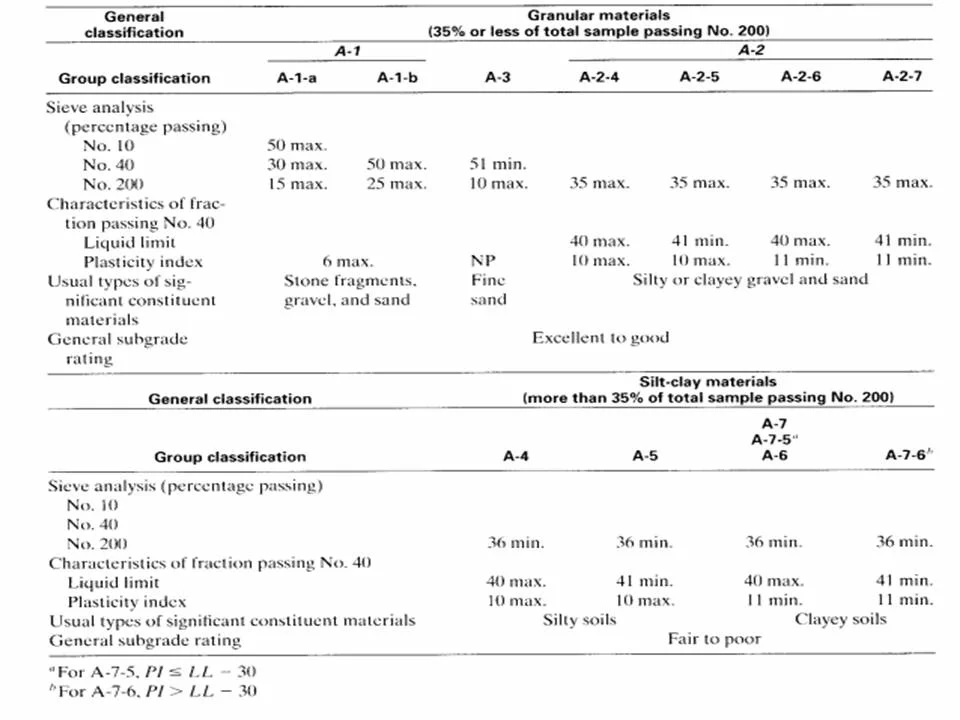
AASHTO Classification for Pavements
Group index calculation and subgrade rating for road designs. Includes CBR correlation from classification data. Follows AASHTO M 145.
Visual-Manual Classification
On-site assessment of soil type, colour, consistency, and structure. Used for preliminary logging and to select laboratory tests. Complies with BS 5930.
Classification for Earthworks
Identification of suitable fill materials and compaction characteristics. Includes plasticity and density index. Supports specification for engineered fills.
Q&A
What is the difference between USCS and AASHTO classification systems?
USCS groups soils by grain size and plasticity for general geotechnical use, giving symbols like CL or SP. AASHTO focuses on pavement subgrade performance, ranking soils from A-1 to A-7 with a group index. Both are standard in UK practice. Our lab applies the relevant system based on the project type.
How long does a full soil classification test take in Middlesbrough?
A standard classification including sieving, hydrometer, and Atterberg limits takes 5 to 7 working days from sample receipt. Wet sieving for glacial tills may add 1 to 2 days. Urgent projects can be prioritised with a 3-day turnaround.
Do I need soil classification if I already have borehole logs?
Borehole logs supply field descriptions but not quantified plasticity indices or grain size curves. Laboratory classification gives the exact USCS symbol and AASHTO group index required for Eurocode 7 design. It also detects organic content that field logging can miss.
What is the typical cost range for soil classification in Middlesbrough?
The cost for a full classification suite including sieving, hydrometer, and Atterberg limits ranges from £50 to £80 per sample. Volume discounts apply for projects with more than ten samples. Additional tests like organic content or specific gravity carry an extra charge.